Tissue Transglutaminase IgA and Industrial Transglutaminase in Meat Processing
Troubleshoot TGase meat processing dosage, pH, temperature, QC, COA/TDS/SDS, pilot validation, and supplier checks without medical confusion.
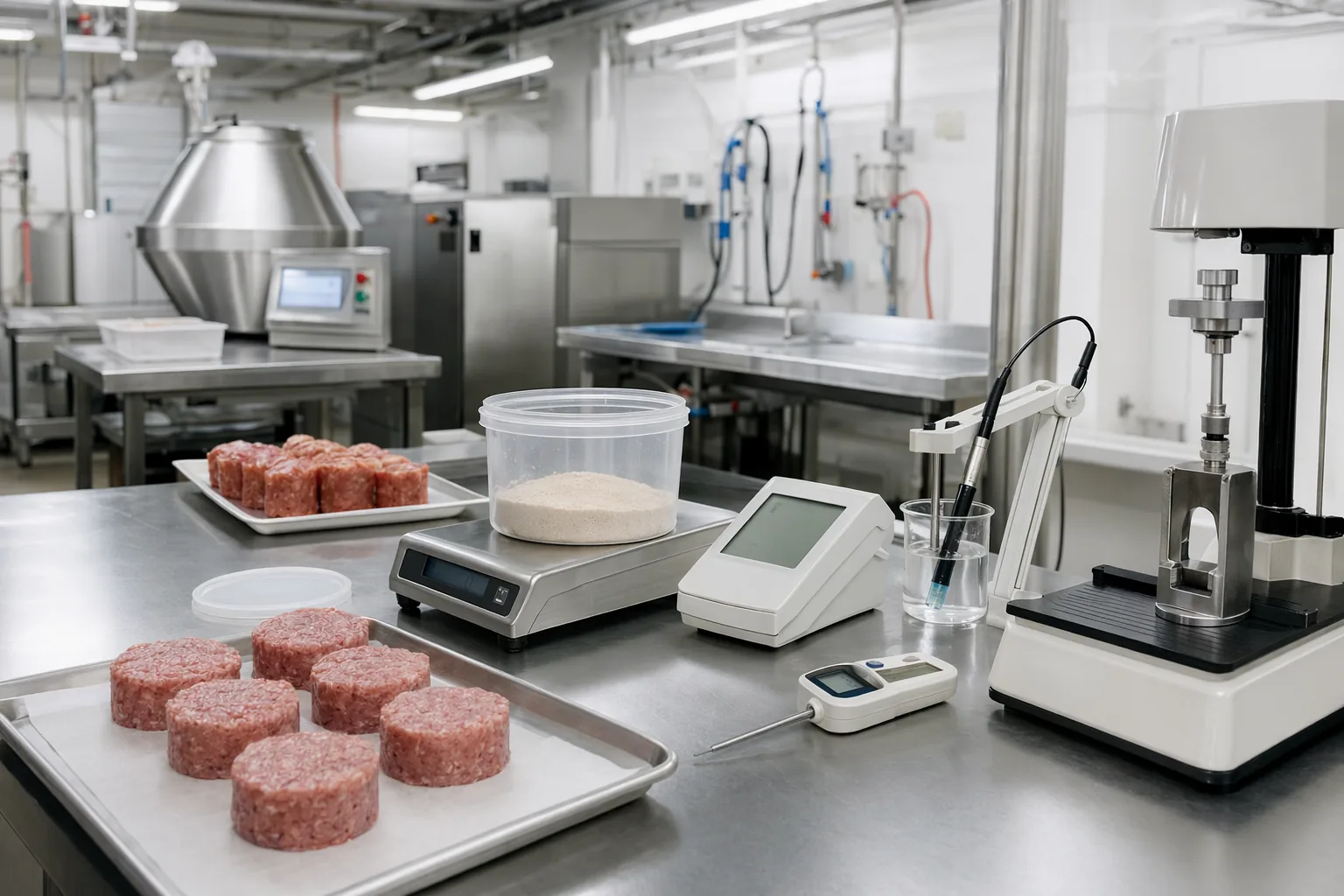
Searching for tissue transglutaminase IgA often leads to clinical terminology, but meat processors need practical guidance on microbial TGase food performance: dosage, pH, temperature, QC, and supplier qualification.
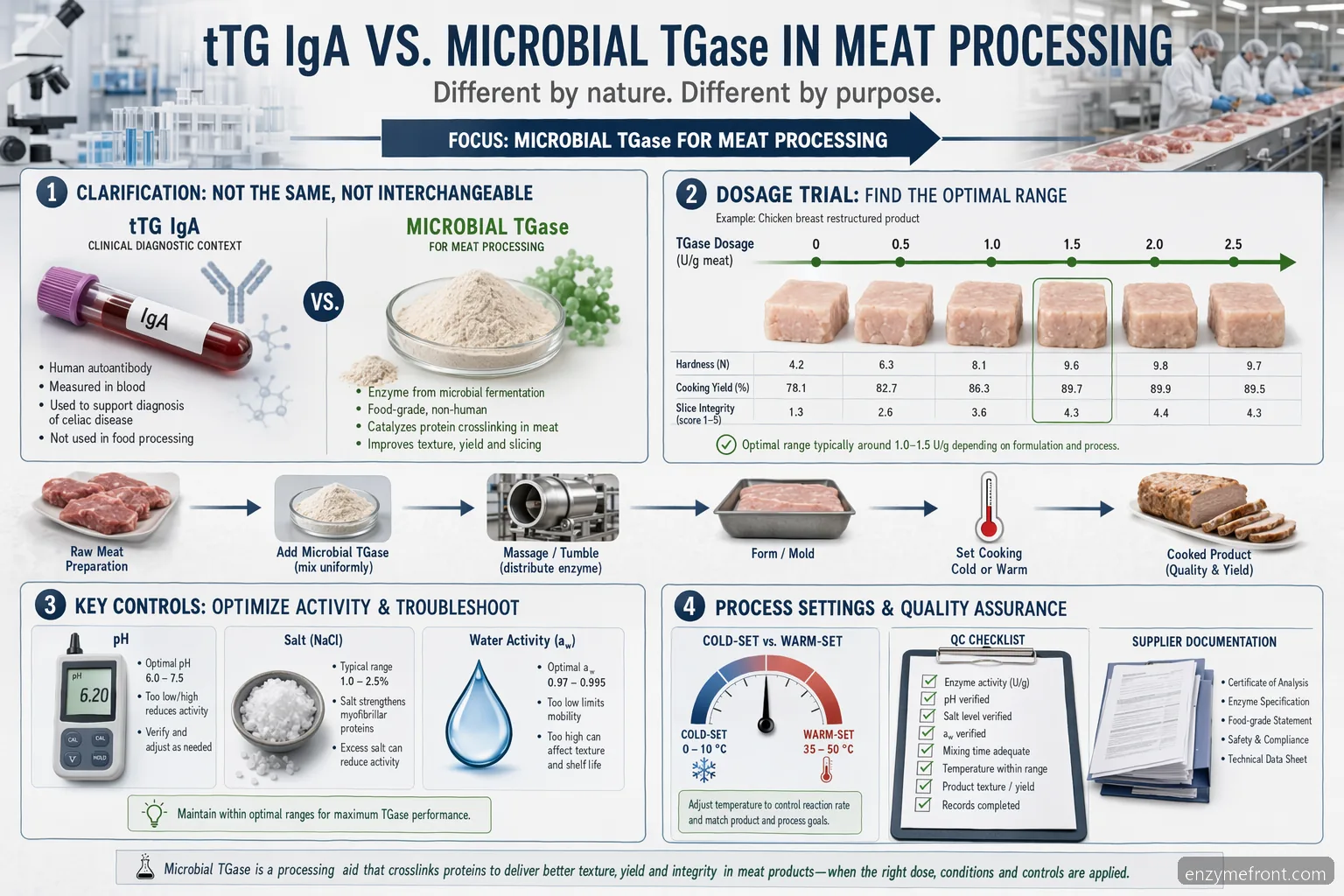
Clarifying the Keyword: Tissue Transglutaminase IgA Is Not Meat Glue
The phrase tissue transglutaminase IgA, including variants such as tiss transglutaminase IgA, tissue transglutaminase ab IgA, tissu transglutaminase IgA lev, anti transglutaminase antibodies, and anticorps anti transglutaminase, usually appears in medical testing contexts. That terminology should not be confused with industrial transglutaminase used in meat processing. Food processors typically source microbial transglutaminase, often called TGase food or transglutaminase meat glue, to cross-link proteins and improve binding in formed, restructured, injected, or value-added meat products. The practical question for procurement and R&D is not medical interpretation; it is whether a specific enzyme grade performs reliably under your raw material, brine, mixing, forming, chilling, cooking, labeling, and regulatory requirements. A qualified supplier should help translate activity units, carrier composition, and process limits into plant-scale operating conditions.
Medical terms: tissue transglutaminase and IgA antibody testing • Industrial term: microbial transglutaminase enzyme for protein binding • Buyer focus: performance, documentation, safety data, and repeatability
Dosage Bands for Meat Processing Trials
For meat processing, transglutaminase dosage depends on enzyme activity, carrier system, protein content, particle size, mixing efficiency, salt level, and desired bind strength. As a practical screening range, many commercial TGase blends are evaluated around 0.2–1.0% of finished product weight. More concentrated enzyme preparations may require substantially lower addition rates, so the supplier’s TDS and activity declaration should always be used. Start with a low, medium, and high dosage ladder, then evaluate yield, sliceability, purge, cook loss, bite, and sensory impact. Excess dosage may not deliver proportional benefit and can raise cost-in-use or alter texture. In restructured meat, uniform distribution is critical; dry tumbling, pre-blending with seasoning, or brine dispersion may be used depending on formulation. Validate against your real plant conditions rather than bench assumptions.
Screen commercial blends at supplier-recommended levels, often 0.2–1.0% • Compare dosage by enzyme activity, not only kilograms per batch • Track cost-in-use per metric ton and per finished serving • Confirm distribution during mixing, tumbling, forming, and stuffing
pH, Salt, and Water Activity Troubleshooting
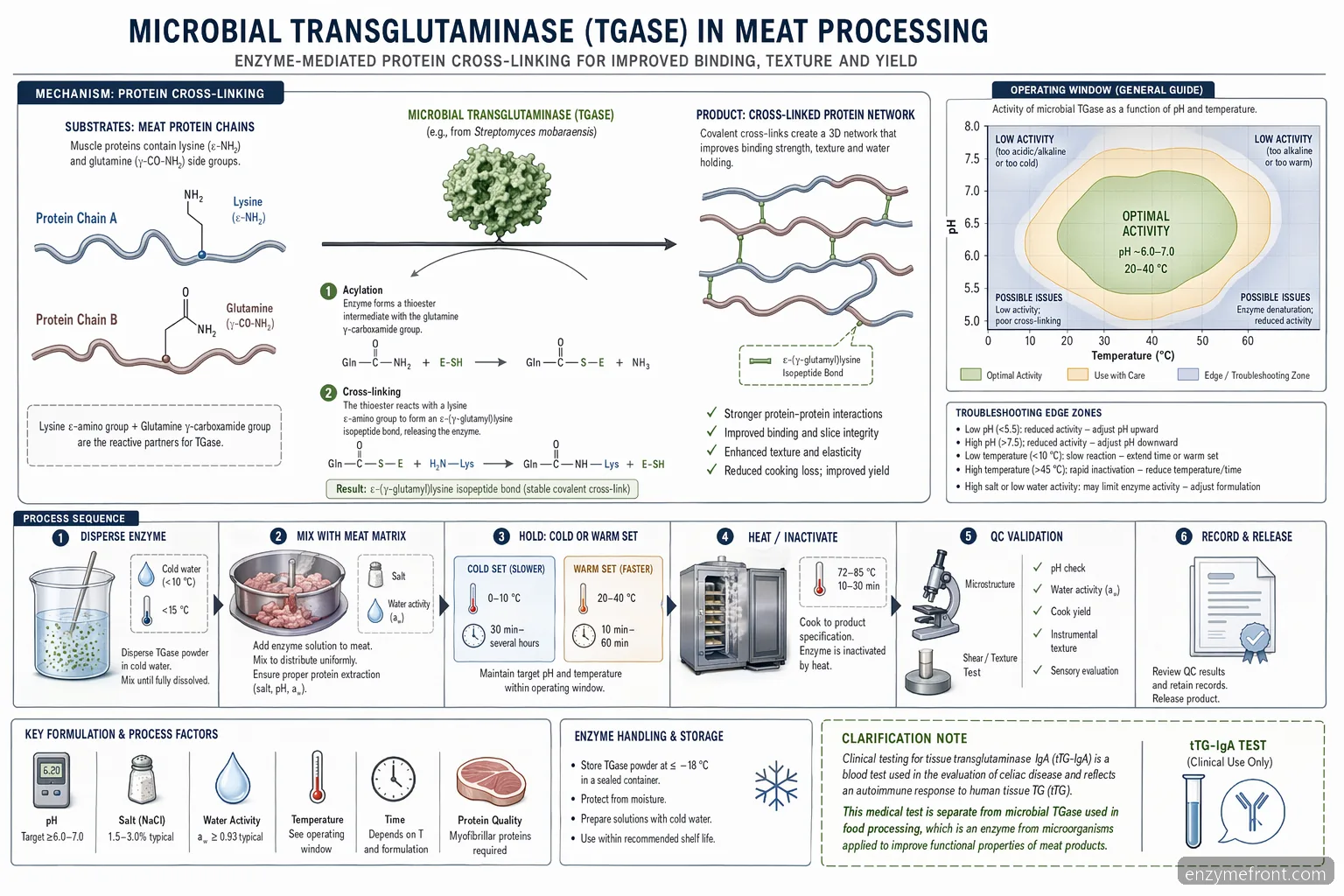
TGase enzyme performance is strongest when the meat system supports protein exposure, enzyme mobility, and sufficient reaction time. Many microbial transglutaminase products operate across approximately pH 5.0–8.0, with practical meat processing performance commonly targeted near pH 5.5–7.5. Very acidic marinades, excessive heat before setting, poor protein extraction, or insufficient contact between pieces can reduce binding. Salt at typical processed-meat levels, often around 1–3%, may support protein functionality, but high ionic strength, aggressive acids, high fat surfaces, or heavy spice particulates can interfere with adhesion. If binding is weak, review raw material pH, thawing practice, surface moisture, salt addition point, mixing energy, and rest time. Your COA confirms batch identity, while the TDS should specify recommended pH range, activity, carrier, and application notes for meat systems.
Target practical pH range: about 5.5–7.5 for many meat applications • Avoid early enzyme exposure to strong acids or excessive heat • Check surface contact, protein extraction, and purge before blaming dosage
Temperature and Holding Time: Cold Set or Warm Set
Temperature strategy is one of the biggest variables in transglutaminase meat glue performance. Chilled setting at 2–8°C is common when processors need food-safety control, overnight binding, or compatibility with existing cold rooms. Depending on formulation and geometry, hold times may range from several hours to overnight. Accelerated setting around 40–50°C can increase reaction speed, but it must be validated carefully because microbial control, texture, fat stability, and downstream cooking schedules may change. Enzyme activity generally declines as product temperature moves outside the supplier’s recommended range, and cooking to typical final heat treatments will inactivate the enzyme. For troubleshooting, measure actual product core temperature, not only room or water temperature. Poor bind often results from short dwell time, uneven temperature, frozen cores, or moving product to cook steps before the protein network is established.
Cold set: commonly 2–8°C for several hours to overnight • Warm set: often screened around 40–50°C with strict validation • Record core temperature, hold time, and time-to-cook in every trial
QC Checks for Pilot Validation
A robust pilot plan should connect transglutaminase dosage to measurable product outcomes. Define a control without enzyme, then test at least three dosage levels under fixed pH, salt, temperature, and hold-time conditions. Useful QC checks include raw material pH, brine pickup, mix time, formed weight, purge after chilling, cook yield, slice integrity, tensile or shear testing, texture profile analysis, and sensory review. For seafood or poultry analog programs, also assess color, drip, and gel strength where relevant. Record lot numbers for meat, enzyme, carriers, spices, and packaging so scale-up issues can be traced. If the product is sold sliced, diced, or vacuum packed, test the finished format rather than only the whole piece. Final approval should include shelf-life, food-safety, labeling, and customer specification review.
Use a no-enzyme control and a dosage ladder • Measure purge, cook yield, sliceability, and texture • Validate the finished commercial format, not only lab samples • Document every lot, hold condition, and process deviation
Supplier Qualification: Documents, Risk, and Cost-in-Use
Industrial buyers should qualify transglutaminase suppliers with the same discipline used for other functional processing aids or ingredients. Request a current COA for each batch, a technical data sheet with activity and application guidance, an SDS for handling, allergen and carrier statements, storage conditions, shelf-life, country of origin, and traceability information. Do not rely on vague claims such as “high strength” without activity data and pilot confirmation. Cost-in-use should include dosage, yield improvement, labor impact, rework reduction, waste reduction, freight, storage, minimum order quantity, and batch-to-batch consistency. Ask for pilot samples and technical support before plant trials. If your product is exported, confirm that the enzyme grade, carrier system, and labeling approach are acceptable for your destination markets with your regulatory team.
Minimum documents: COA, TDS, SDS, allergen statement, traceability data • Compare cost-in-use, not only price per kilogram • Approve suppliers after pilot validation and plant-scale confirmation
Technical Buying Checklist
Buyer Questions
No. Tissue transglutaminase IgA, tissue transglutaminase ab IgA, and anti transglutaminase antibodies are clinical testing terms. Meat processors generally use microbial transglutaminase enzyme for protein cross-linking. For industrial purchasing, focus on TGase activity, carrier composition, dosage guidance, COA, TDS, SDS, and validated process performance rather than medical terminology.
A practical first screen for many commercial transglutaminase blends is a low, medium, and high ladder within the supplier’s recommended range, often around 0.2–1.0% of finished product weight. More concentrated products may need less. Always compare by declared activity, product performance, and cost-in-use, then confirm the best level in plant-scale trials.
Common causes include uneven enzyme distribution, insufficient protein extraction, low contact between meat surfaces, too little hold time, frozen cores, excessive purge, unsuitable pH, or temperature deviations. Check product core temperature, raw material pH, mix energy, salt addition, forming pressure, and chill dwell time. Compare each batch against a documented control and the supplier’s TDS.
Yes, many meat processors validate chilled setting at 2–8°C because it fits cold-chain operations and supports microbial control. Reaction speed is slower than warm setting, so several hours to overnight may be required. The correct hold time depends on product size, formulation, enzyme activity, and required texture. Confirm performance with pilot and plant validation.
Request a batch COA, technical data sheet, SDS, allergen statement, carrier information, shelf-life, storage conditions, country of origin, and traceability details. For B2B approval, also ask for pilot samples, application guidance, and documentation of activity units. Supplier qualification should include performance testing, cost-in-use comparison, and confirmation by your quality and regulatory teams.
Transglutaminase (TGase) for Research & Industry
Need Transglutaminase (TGase) for your lab or production process?
ISO 9001 certified · Food-grade & research-grade · Ships to 80+ countries
Frequently Asked Questions
Is tissue transglutaminase IgA the same as transglutaminase meat glue?
No. Tissue transglutaminase IgA, tissue transglutaminase ab IgA, and anti transglutaminase antibodies are clinical testing terms. Meat processors generally use microbial transglutaminase enzyme for protein cross-linking. For industrial purchasing, focus on TGase activity, carrier composition, dosage guidance, COA, TDS, SDS, and validated process performance rather than medical terminology.
What TGase dosage should a meat processor test first?
A practical first screen for many commercial transglutaminase blends is a low, medium, and high ladder within the supplier’s recommended range, often around 0.2–1.0% of finished product weight. More concentrated products may need less. Always compare by declared activity, product performance, and cost-in-use, then confirm the best level in plant-scale trials.
Why is my transglutaminase bind strength inconsistent?
Common causes include uneven enzyme distribution, insufficient protein extraction, low contact between meat surfaces, too little hold time, frozen cores, excessive purge, unsuitable pH, or temperature deviations. Check product core temperature, raw material pH, mix energy, salt addition, forming pressure, and chill dwell time. Compare each batch against a documented control and the supplier’s TDS.
Can TGase work in chilled meat processing?
Yes, many meat processors validate chilled setting at 2–8°C because it fits cold-chain operations and supports microbial control. Reaction speed is slower than warm setting, so several hours to overnight may be required. The correct hold time depends on product size, formulation, enzyme activity, and required texture. Confirm performance with pilot and plant validation.
What documents should I request before buying transglutaminase enzyme?
Request a batch COA, technical data sheet, SDS, allergen statement, carrier information, shelf-life, storage conditions, country of origin, and traceability details. For B2B approval, also ask for pilot samples, application guidance, and documentation of activity units. Supplier qualification should include performance testing, cost-in-use comparison, and confirmation by your quality and regulatory teams.
Ready to source?
Turn This Guide Into a Supplier Brief Request TGase samples, COA/TDS/SDS, and a meat-processing pilot plan from EnzymeFront.
Contact Us to Contribute