Transglutaminase Supplier Guide for Meat Processing
Source transglutaminase for meat processing with guidance on dosage, pH, temperature, QC, COA/TDS/SDS review, and supplier qualification.
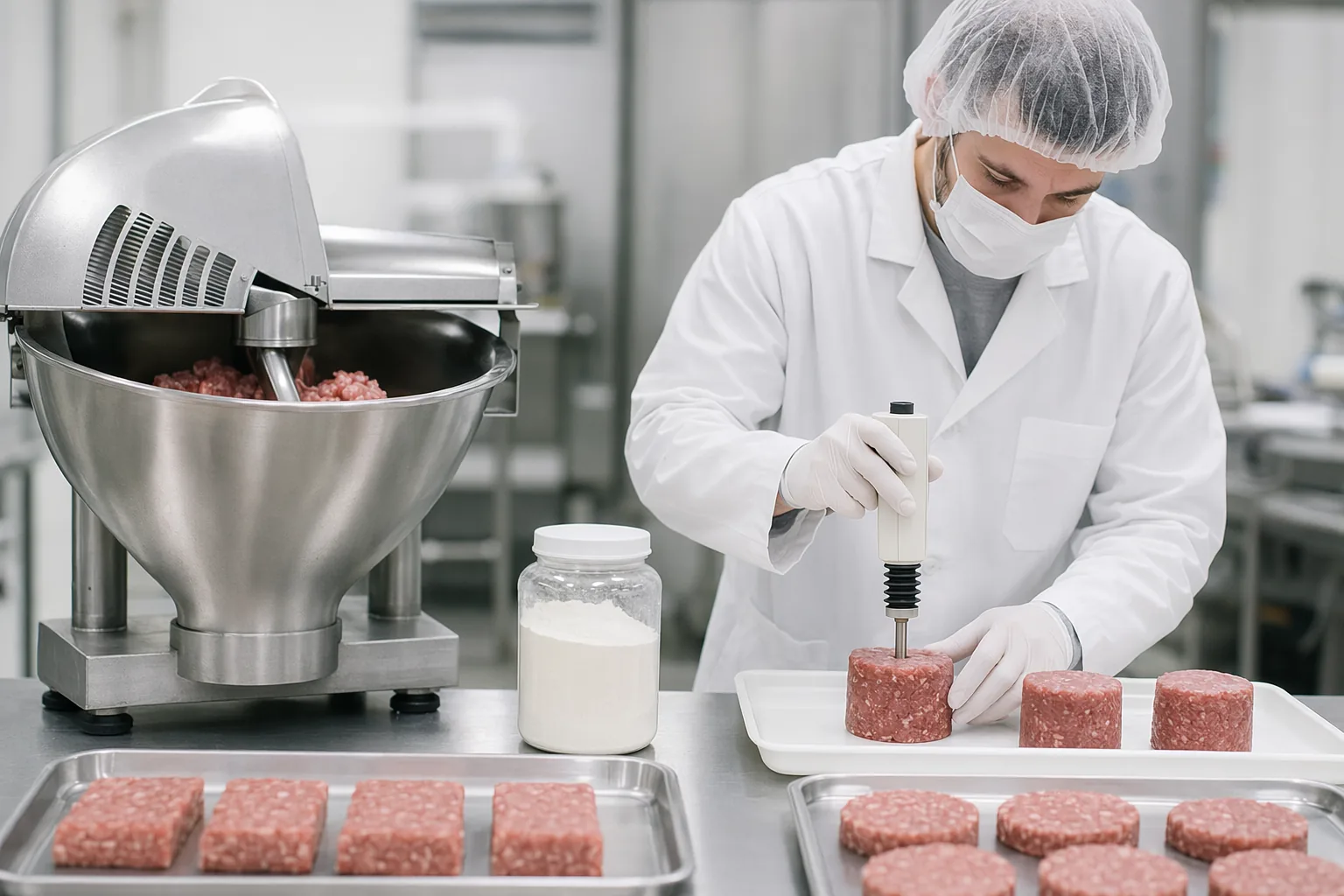
For meat processors, transglutaminase can improve binding, texture, slicing, and yield when it is specified, validated, and controlled as an industrial food enzyme.
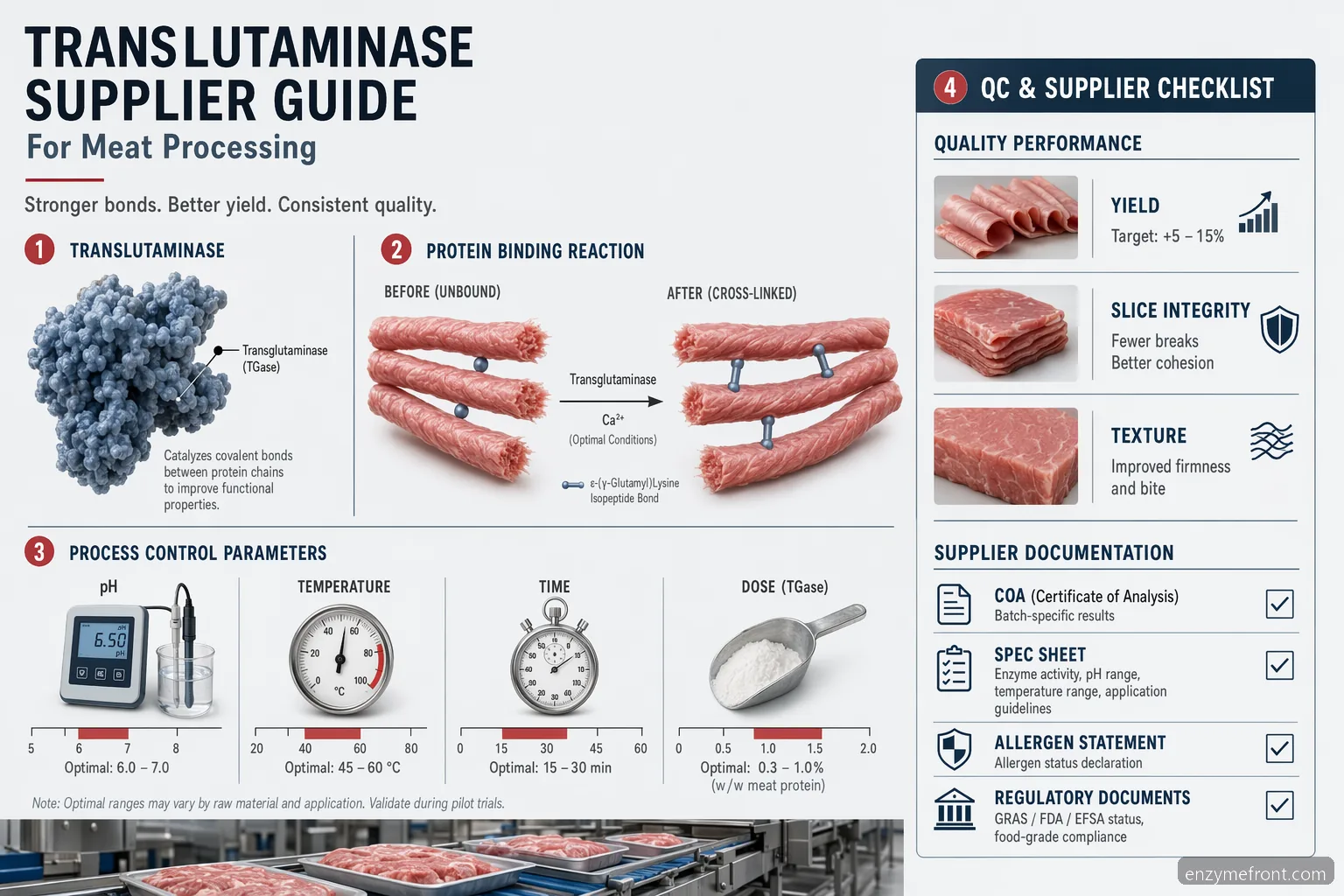
Why meat processors source transglutaminase
Transglutaminase, often called TGase food enzyme or transglutaminase meat glue in processing discussions, catalyzes cross-links between glutamine and lysine residues in proteins. In meat processing, this can help bind trim, form portion-controlled products, improve slice integrity, reduce purge, and support consistent texture in emulsified, restructured, or value-added items. Buyers should treat it as a functional processing aid or ingredient according to local rules, not as a generic commodity. The best grade depends on meat type, particle size, salt system, fat level, hydration, mixing energy, and the target product format. A supplier should help translate enzyme activity into a practical dose for your formulation and line speed. Procurement teams should compare technical fit, documentation, lot consistency, and pilot support before negotiating price.
Common applications include formed steaks, poultry portions, ham, sausages, meat snacks, and seafood blends. • Performance depends on contact between proteins, moisture control, and enough holding time. • Labeling and use limits must be checked against the destination market.
Process conditions for pilot validation
Start with a controlled pilot rather than adding transglutaminase directly to full-scale production. Many meat systems are screened at 0.05-0.5% enzyme preparation by finished product weight, but dosage should be adjusted to the activity stated on the TDS and the required binding strength. TGase generally performs well near pH 5.5-7.2 in meat matrices. Reaction can occur under chilled conditions, for example 2-8°C for several hours, or faster at warmer process temperatures such as 35-50°C where food safety and product design allow. Mixing should distribute the enzyme uniformly without overworking the texture. After reaction, cooking or thermal processing should be validated to stop activity and meet the finished product specification. Record time, temperature, pH, salt, phosphate, moisture, and hold conditions for every trial.
Run a no-enzyme control and at least two dosage levels. • Check enzyme dispersion in dry blend, slurry, or direct addition format. • Validate thermal step and chilled shelf-life under your HACCP plan.
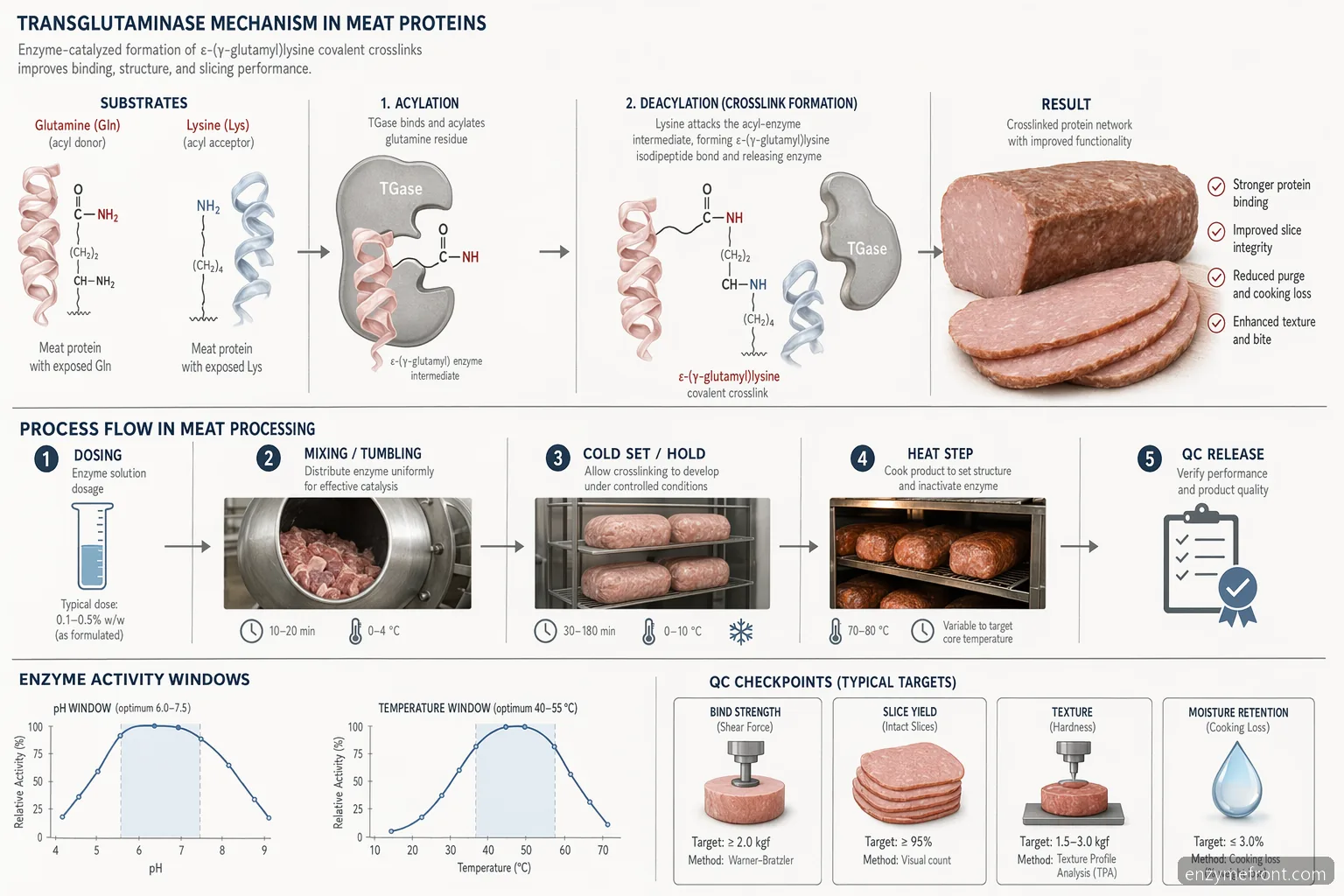
QC checks that prove value
A transglutaminase supplier should support measurable quality control, not only provide a sample. For formed and restructured meat, evaluate binding strength, sliceability, cook yield, purge, texture profile, bite, appearance, and sensory acceptance. For injected or tumbled products, include moisture retention, protein extraction, and brine compatibility. For emulsified products, compare gel strength, fat stability, and casing performance. Microbiological checks are essential because enzyme reaction time may extend holding steps; validate the process with your food safety team. Cost-in-use should include dose, yield change, rework reduction, labor impact, throughput, rejected product, and customer complaints. A lower-priced enzyme can be more expensive if activity varies, dispersion is poor, or technical support is unavailable when scale-up problems occur.
Use texture analyzer, shear test, or standardized slice-loss methods where possible. • Compare cooked yield and purge after storage, not only immediately after production. • Track batch-to-batch performance against the COA activity range.
Documents to request from suppliers
Before purchasing production quantities, request the COA, TDS, SDS, allergen information, ingredient statement, country of origin, shelf-life, storage conditions, recommended handling practices, and batch traceability details. The COA should identify lot number, enzyme activity or assay reference, microbiological limits, and relevant contaminants or composition parameters offered by the supplier. The TDS should explain dosage guidance, suitable pH and temperature range, inactivation guidance, carrier ingredients, and application notes for meat processing. The SDS should cover safe industrial handling, dust control, respiratory sensitization precautions, and storage. Avoid suppliers that provide vague activity units, incomplete lot traceability, or unverifiable claims. If your customers require specific dietary, religious, or export documentation, confirm availability before pilot work to prevent a successful technical trial from becoming a commercial delay.
Match documentation to the exact grade and lot supplied. • Confirm storage temperature and shelf-life after opening. • Ask whether the carrier contains allergens or labeling-sensitive ingredients.
Supplier qualification and scale-up
Supplier qualification should combine technical testing, documentation review, commercial reliability, and change-control expectations. Ask how the manufacturer controls fermentation, downstream processing, blending, enzyme activity, microbial specifications, and packaging. Confirm whether the supplier can provide consistent lead times, reserve capacity, and advance notification of specification or formulation changes. During scale-up, test the enzyme on your actual equipment because mixer type, batch size, vacuum, tumbling time, and forming pressure can change performance. Establish an agreed specification for incoming lots and a troubleshooting route for deviations. Search traffic may include medical phrases such as tissue transglutaminase, tissue transglutaminase iga, tissue transglutaminase ab iga, anti transglutaminase antibodies, or anticorps anti transglutaminase; those terms relate to clinical testing, not industrial TGase purchasing.
Approve suppliers only after pilot validation and document review. • Define change notification expectations in purchasing agreements. • Keep a retained sample from critical production lots.
Technical Buying Checklist
Buyer Questions
In meat processing, transglutaminase is often informally called meat glue because it helps cross-link proteins and bind pieces together. The term can be imprecise, so buyers should specify the exact TGase food enzyme grade, activity, carrier system, and intended application. Confirm local labeling, permitted use, and customer disclosure requirements before commercial launch.
A practical screening range is often 0.05-0.5% enzyme preparation by finished product weight, but the correct dose depends on the supplier’s activity units, meat protein content, salt level, process temperature, contact time, and target texture. Always run a control, at least two dosage levels, and a repeat batch before setting a production standard.
Request the COA, TDS, SDS, allergen statement, ingredient declaration, country of origin, shelf-life, storage guidance, and batch traceability. The COA confirms lot-specific quality, the TDS guides processing, and the SDS supports safe industrial handling. For export or customer-specific programs, confirm any additional documentation before starting validation.
Do not compare transglutaminase only by price per kilogram. Calculate cost-in-use by enzyme dose, activity, yield gain, reduced purge, sliceability, rejected product, labor, line speed, and shelf-life impact. A consistent enzyme with strong technical support may deliver lower total cost than a cheaper grade that requires higher dosage or causes variable texture.
No. Search phrases such as tissue transglutaminase IgA, tiss transglutaminase iga, tissu transglutaminase iga lev, and tissue transglutaminase ab iga refer to clinical antibody testing contexts. Industrial transglutaminase for meat processing is purchased for protein cross-linking functionality. This page is for B2B food manufacturing, not medical diagnosis or supplement advice.
Transglutaminase (TGase) for Research & Industry
Need Transglutaminase (TGase) for your lab or production process?
ISO 9001 certified · Food-grade & research-grade · Ships to 80+ countries
Frequently Asked Questions
Is transglutaminase the same as meat glue?
In meat processing, transglutaminase is often informally called meat glue because it helps cross-link proteins and bind pieces together. The term can be imprecise, so buyers should specify the exact TGase food enzyme grade, activity, carrier system, and intended application. Confirm local labeling, permitted use, and customer disclosure requirements before commercial launch.
What dosage should a meat processor test first?
A practical screening range is often 0.05-0.5% enzyme preparation by finished product weight, but the correct dose depends on the supplier’s activity units, meat protein content, salt level, process temperature, contact time, and target texture. Always run a control, at least two dosage levels, and a repeat batch before setting a production standard.
Which documents are essential before buying production lots?
Request the COA, TDS, SDS, allergen statement, ingredient declaration, country of origin, shelf-life, storage guidance, and batch traceability. The COA confirms lot-specific quality, the TDS guides processing, and the SDS supports safe industrial handling. For export or customer-specific programs, confirm any additional documentation before starting validation.
How should cost-in-use be calculated?
Do not compare transglutaminase only by price per kilogram. Calculate cost-in-use by enzyme dose, activity, yield gain, reduced purge, sliceability, rejected product, labor, line speed, and shelf-life impact. A consistent enzyme with strong technical support may deliver lower total cost than a cheaper grade that requires higher dosage or causes variable texture.
Are tissue transglutaminase IgA terms relevant to food enzyme buying?
No. Search phrases such as tissue transglutaminase IgA, tiss transglutaminase iga, tissu transglutaminase iga lev, and tissue transglutaminase ab iga refer to clinical antibody testing contexts. Industrial transglutaminase for meat processing is purchased for protein cross-linking functionality. This page is for B2B food manufacturing, not medical diagnosis or supplement advice.
Ready to source?
Turn This Guide Into a Supplier Brief Request a transglutaminase sample, COA, TDS, SDS, and pilot support for your meat processing line.
Contact Us to Contribute