Microbial Transglutaminase: Grades, Packs and Documents for Bulk Buyers
Wholesale microbial transglutaminase for food manufacturers, distributors and resellers: activity grades, application grades, packs, documents and quotes.
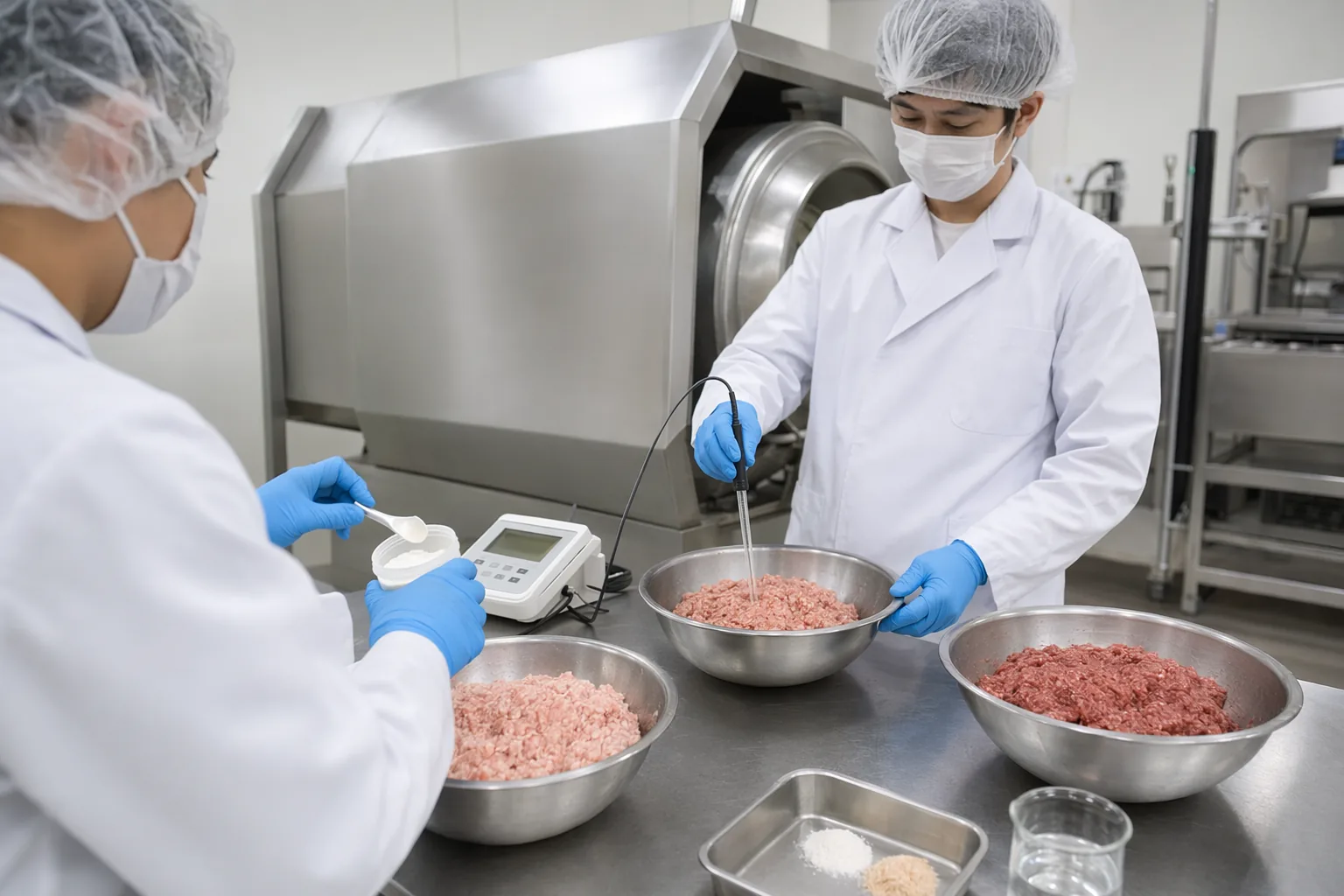
This guide is for food manufacturers, distributors and resellers who buy microbial transglutaminase (TGase) in bulk. It explains how the enzyme is graded and packed in trade, why application grades differ from plain activity grades, which documents to ask for, and what to send with a quote request. Pricing, lead time and freight are quoted per order.
What a Bulk Buyer Is Actually Purchasing
Microbial transglutaminase (EC 2.3.2.13) is produced by fermentation of Streptomyces mobaraensis. TGase cross-links glutamine and lysine residues in food proteins. Food processors use it to bind and set protein in meat, seafood, dairy gels, noodles, gluten-free dough and soy products.
What ships in the bag is an enzyme preparation, not pure enzyme: a white to off-white powder with a declared activity per gram (U/g), with the rest made up of carrier and, in some grades, other functional ingredients. Food-grade TGase is identified by CAS number 80146-85-6 together with its declared activity; put both on your purchase specification.
This is a food-processing enzyme only. Tissue transglutaminase (tTG, also called TG2) and the IgA or IgG antibody tests named after it belong to medical diagnostics, a different product and a different buyer.
Activity Grades and Pack Formats
Food-grade TGase is sold by declared activity. A 130 U/g grade packed in 1 kg bags is one example of how the product is offered in trade. Our own supply covers 100 – 200 U/g, packed in 1 kg bags inside 10 kg boxes, with a minimum order of 10 kg. Larger volumes are quoted per order.
Compare grades on the activity delivered to each finished batch, not on the weight of powder. A higher-activity grade means less powder for the same enzyme input, so the dose on your formulation sheet must follow the activity printed on the TDS of the lot you receive.
Shelf life is 12 months under proper storage, or 24 months frozen. Keep bags sealed in a cool, dry place and reseal opened bags promptly.
Declared activity: 100 – 200 U/g • Packing: 1 kg bags / 10 kg boxes • MOQ: 10 kg • Larger volumes: quoted per order
Application Grades: Meatballs, Sausages, Vegetarian Foods and Tofu
Besides plain activity grades, TGase is also offered as application grades: separate 1 kg bags labelled for meatballs, for ham and grilled sausages, for vegetarian imitation-meat foods, and for binding thousand-layer tofu, a pressed, layered soy product. An application grade is TGase made up for one product type, so its composition, dose and label declaration differ from a plain activity grade.
For distributors and resellers this is the first question to settle with each customer: does the processor want a plain activity grade it can dose itself, or a ready application grade for one product line? A plain grade suits formulators with their own trial capacity. An application grade suits processors who want a starting point for one product, but ask for its full composition and allergen statement before you list it, because added proteins or other ingredients change the label.
Soy and tofu processors are buyers in their own right: the enzyme sets soy protein as well as meat protein, which is why it is offered for pressed tofu and vegetarian foods. Trial it in your own curd or gel system before you fix a specification.
Plain activity grade: you set the dose • Application grade: made up for one product • Always request composition and allergen statement
Documents to Request Before a First Order
Ask for a lot-specific COA, a TDS that states the activity and the method used to measure it, an SDS for industrial handling, the ingredient composition with an allergen statement, storage conditions and shelf life, and batch traceability. For an application grade, the composition sheet matters most, because it decides how your customer declares the product.
Resellers should also agree how specification or formulation changes are notified, and keep a retained sample of each lot they sell on. If your customers need dietary, religious or export documents, confirm what is available for the exact grade before the pilot, so a good trial does not stall at approval.
COA per lot • TDS with activity method • SDS • Composition and allergen statement • Traceability and change notification
Trial Before You Scale
Set the dose on your own product, line and raw materials. Run a no-enzyme control and at least three dose levels, hold time and temperature as in production, and judge the result on bind or gel strength, texture, yield and appearance after storage, not only on the day of production.
Our specification gives a working range of pH 5.0 – 8.0 and 40°C – 55°C. If your line sets the product cold over a longer hold instead, validate that time and temperature under your food-safety plan, and confirm that the final heat step stops the reaction.
No-enzyme control plus three dose levels • Production time and temperature • Check results after storage
Clarification: Tissue Transglutaminase and Antibody Tests
Searches such as tissue transglutaminase IgA, tissue transglutaminase IgG, tTG antibodies, transglutaminase IgA autoantibodies and tissue transglutaminase 2 refer to clinical testing. Questions about those tests belong with a qualified healthcare professional. This site supplies microbial transglutaminase for food manufacturing and gives no medical, diagnostic or supplement advice.
Technical Buying Checklist
Grade type: plain activity grade or application grade for one product
Declared activity (U/g) and CAS number on the purchase specification
Pack format and quantity: 1 kg bags / 10 kg boxes; MOQ 10 kg; larger volumes quoted per order
Documents: COA, TDS with activity method, SDS, composition and allergen statement, traceability
Storage on arrival: sealed, cool and dry; 12 months shelf life (24 months frozen)
Pilot: no-enzyme control plus three dose levels on your own line
Request a Wholesale Quote
Send us the product you need (activity grade or application grade), the quantity in kilograms, the pack format, the destination country and the application it is for. We reply with documents, a sample route and a quotation; pricing, lead time and freight are quoted per order. Use the inquiry form on this site or write to hello@mail.enzymefront.com.
Transglutaminase (TGase) for Research & Industry
Need Transglutaminase (TGase) for your lab or production process?
ISO 9001 certified · Food-grade & research-grade · Ships to 80+ countries
Frequently Asked Questions
Which activity grades and pack sizes can we order?
Our microbial transglutaminase is supplied at 100 – 200 U/g as a white to off-white powder, packed in 1 kg bags inside 10 kg boxes, with a minimum order of 10 kg. Larger volumes, pricing and lead time are quoted per order.
What is an application grade of transglutaminase?
It is TGase made up for one product type, for example meatballs, sausages, vegetarian imitation-meat foods or thousand-layer tofu, instead of a plain activity grade that the processor doses itself. Ask for its full composition and allergen statement, because the extra ingredients change dose and labelling.
Is transglutaminase the same as meat glue?
Meat glue is an informal market name for transglutaminase used to bind protein pieces. For purchasing, specify it as a transglutaminase enzyme preparation with a declared activity, composition, documents and regulatory status for your market.
What should we send to get a wholesale quote?
The product (activity grade or application grade), quantity in kilograms, pack format, destination country and application. Send it through the inquiry form or to hello@mail.enzymefront.com; pricing, lead time and freight are quoted per order.
Does this page cover tissue transglutaminase IgA testing?
No. Tissue transglutaminase IgA and related antibody tests are medical diagnostics and should be discussed with a qualified healthcare professional. This site supplies microbial transglutaminase for food manufacturing only.
Wholesale TGase: Request a Quote
For manufacturers, distributors and resellers: send the grade, quantity, pack format and destination, and we will reply with COA, TDS, SDS, a sample route and a quotation. Request a microbial transglutaminase sample, COA, TDS, SDS, and pilot-trial support for your formulation.
Contact Us to Contributehello@mail.enzymefront.com