Tissue Transglutaminase Ab IgG: Industrial TGase Use in Meat Processing
Industrial guide to transglutaminase meat processing: dosage, pH, temperature, QC, COA/TDS/SDS, pilot validation, and suppliers.
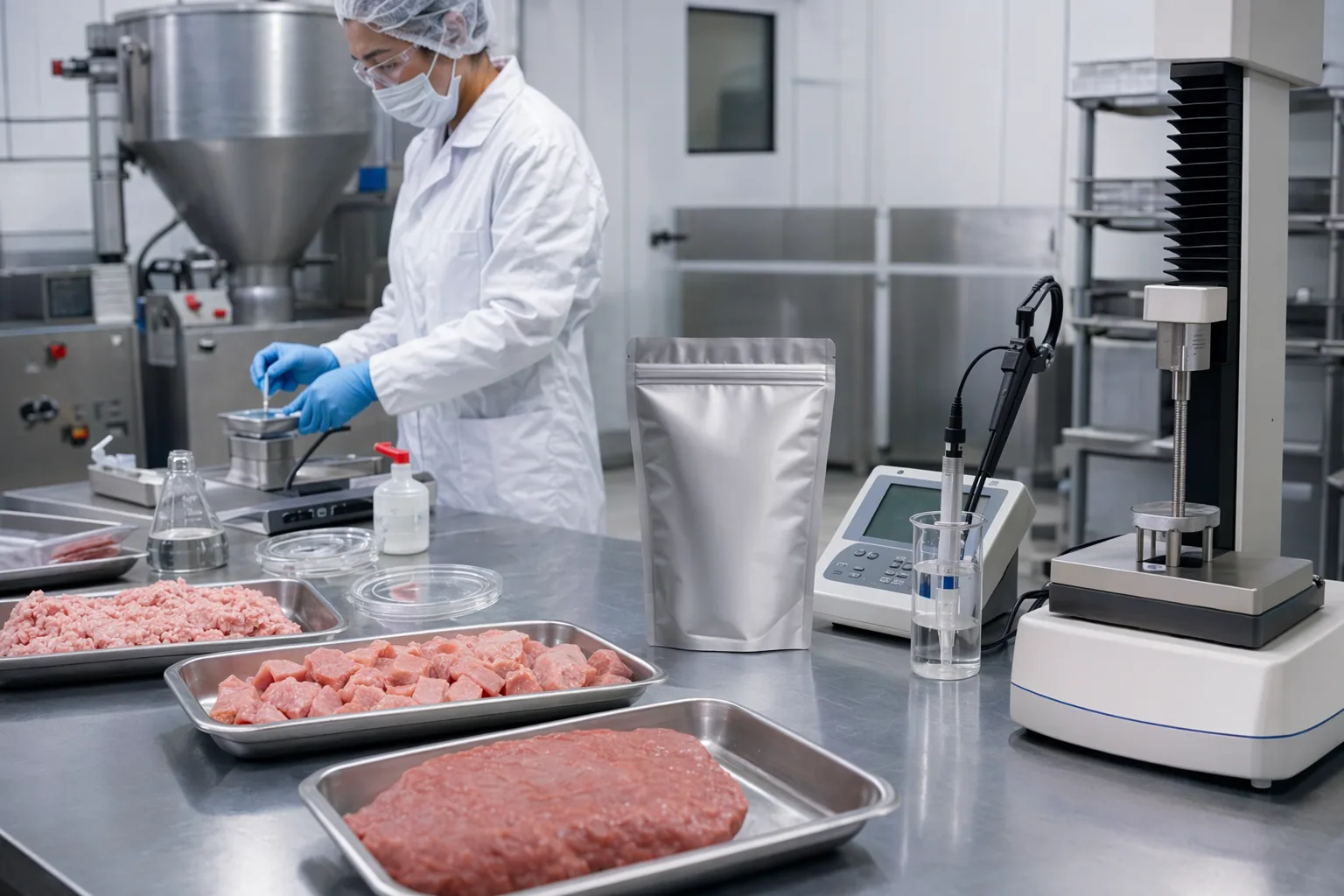
For meat processors, the practical question is not medical testing but how to specify, dose, validate, and source transglutaminase enzyme for consistent protein binding, texture, and yield.
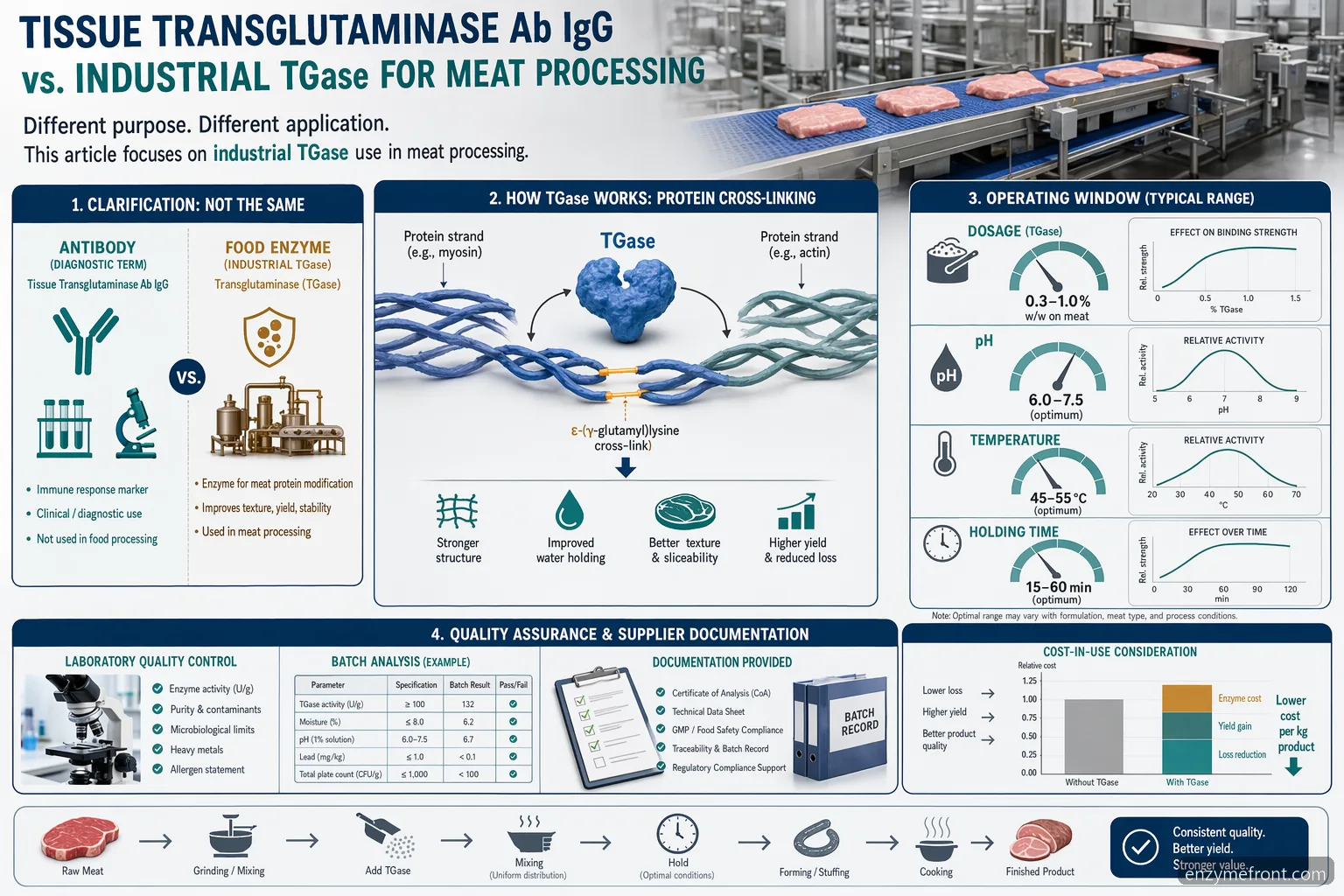
Clarifying the Keyword: Antibody Term vs Food Enzyme
The phrase tissue transglutaminase Ab IgG belongs to clinical antibody testing, not meat processing formulation. Similar search phrases such as tissue transglutaminase iga, tissue transglutaminase ab iga, tiss transglutaminase iga, anti transglutaminase antibodies, and tissu transglutaminase iga lev refer to diagnostics and should not be used as purchasing specifications for food production. In industrial meat processing, the relevant ingredient is food-grade microbial transglutaminase, often shortened to transglutaminase, transglutaminase enzyme, TGase food, or transglutaminase meat glue. It catalyzes covalent crosslinks between protein-bound glutamine and lysine residues, helping improve binding in restructured meat, poultry, seafood analogs, and composite protein systems. Procurement teams should separate medical terminology from food-enzyme documentation and request technical documents that describe activity, carrier system, use level, storage, and regulatory suitability for the target market.
Do not treat antibody-test terminology as an enzyme grade or activity unit. • Specify microbial transglutaminase for food processing applications. • Confirm intended use, labeling requirements, and local regulatory status before launch.
How Transglutaminase Works in Meat Formulations
In meat processing, transglutaminase forms stable protein-protein bonds that can improve sliceability, bite, cohesion, and visual integrity when lean trim, whole-muscle pieces, emulsions, or comminuted systems are combined. Performance depends on accessible myofibrillar proteins, moisture distribution, ionic strength, mixing efficiency, and contact time. Salt can help extract functional proteins, while phosphates, hydrocolloids, starches, or dairy proteins may alter water binding and texture. TGase is not a substitute for hygienic handling, cold-chain control, or validated cooking; it is a formulation tool that must fit the process. For restructured meat, the enzyme is commonly dispersed in dry seasoning, brine, slurry, or surface application, then evenly distributed before forming, stuffing, tumbling, or vacuum packaging. The best results come from matching enzyme activity, dose, and activation time to the raw material variability and finished-product specification.
Target products: formed steak, ham systems, poultry rolls, surimi blends, and seafood portions. • Key variables: protein availability, moisture, salt, pH, time, and temperature. • Uneven distribution can cause weak spots or localized over-firm texture.
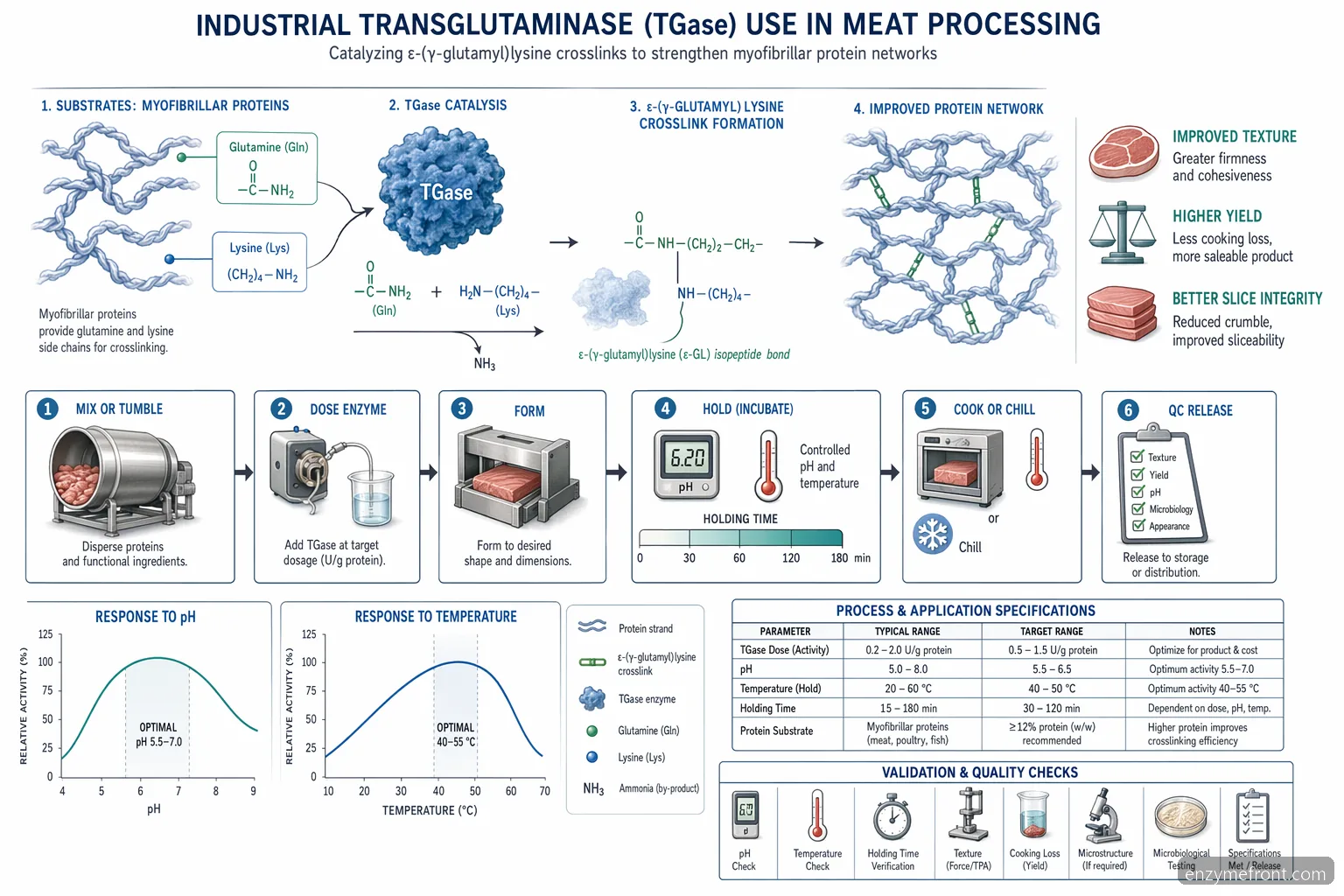
Starting Dosage, pH, Temperature, and Holding Time
A practical bench trial for meat systems often starts with 0.1–1.0% transglutaminase enzyme preparation based on finished formulation weight, then narrows the range according to activity units stated on the TDS and COA. Some high-protein, finely comminuted systems may need less, while low-protein or high-fat systems may need process changes rather than more enzyme. Many microbial TGase products perform in approximately pH 5.0–8.0, with useful activity under chilled conditions and higher activity as temperature rises. For formed chilled meat, processors often evaluate 2–6°C holding for 4–24 hours. Where food safety, texture, and throughput permit, warm activation around 40–50°C for 20–60 minutes may accelerate bonding, followed by validated thermal processing or chilling. Final parameters should be confirmed by pilot trials because carrier composition, activity level, and raw meat variability can change results.
Trial band: 0.1–1.0% enzyme preparation, not a universal final dose. • Common pH window: about 5.0–8.0, depending on product and enzyme grade. • Cold hold: 2–6°C for 4–24 hours is a typical validation range. • Warm activation: 40–50°C may be useful only in controlled, validated processes.
Process Integration for B2B Meat Plants
Successful TGase use depends on repeatable handling rather than simply increasing dosage. Dry blends should be dispersed uniformly to avoid clumping, and liquid slurries should be used promptly to limit premature reaction or activity loss. Vacuum tumbling can improve contact between protein surfaces, while forming pressure helps bring pieces close enough for bonding. For whole-muscle restructuring, control cut size, surface area, salt level, and dwell time. For emulsified or comminuted products, evaluate texture after cooking, cooling, slicing, and shelf-life storage, not only immediately after activation. Enzyme activity can decline with improper storage, excessive heat, or extended exposure to moisture, so warehouse conditions and opened-bag handling matter. Build TGase into the HACCP or food safety plan as an ingredient and process step, while keeping microbial safety controls independent from enzyme functionality.
Add enzyme as late as practical when the process involves extended pre-mixing. • Keep enzyme powder dry and sealed before use. • Validate mixing uniformity and contact time at production scale. • Do not rely on TGase to correct poor raw material quality.
QC Checks, Pilot Validation, and Cost-in-Use
Before commercial adoption, run pilot batches across normal raw material variation, including lean-to-fat ratio, pH, purge, frozen-thawed status, and supplier lots. QC should measure bind strength, cook yield, purge loss, slice integrity, texture profile, sensory attributes, and appearance after chilling or reheating. Track defects such as rubbery bite, brittle texture, uneven bonding, excessive moisture release, or visible seams. Cost-in-use should be calculated from the actual effective dose, yield improvement, labor impact, rework reduction, line speed, and any added holding time or equipment constraints. A higher-priced enzyme may be more economical if activity is consistent and dosage is lower, but only validated plant data can prove it. Document the formulation, process window, acceptance criteria, and corrective actions before full-scale rollout.
Compare control, low-dose, target-dose, and high-dose batches. • Test finished product after cooking, cooling, slicing, and storage. • Calculate cost per metric ton of finished product, not only price per kilogram of enzyme. • Use pilot results to set release specifications and operating limits.
Supplier Qualification and Documentation
Industrial buyers should qualify a transglutaminase supplier with the same discipline used for other functional food ingredients. Request a current COA for each lot, a TDS with activity definition and recommended use conditions, and an SDS for safe handling. Confirm ingredient composition, carriers, allergens, country of origin, storage conditions, shelf life, packaging format, and traceability. Ask how enzyme activity is measured, whether activity units are comparable between lots, and what variability range is expected. Supplier evaluation should include responsiveness, sample availability, technical support, change-control communication, and ability to support pilot validation. Avoid unverifiable claims and require documentation suitable for your target market and customer audits. For multi-site processors, align specifications across plants so dosage, storage, and QC methods remain consistent.
Required documents: COA, TDS, SDS, allergen statement, and ingredient declaration. • Check lot-to-lot activity consistency and recommended storage. • Confirm supplier change notification practices. • Keep approved samples and retain records for audit traceability.
Technical Buying Checklist
Buyer Questions
No. Tissue transglutaminase Ab IgG is a clinical antibody-testing phrase, while meat-processing transglutaminase is a food-grade microbial enzyme preparation. Industrial buyers should specify the enzyme by activity, composition, intended food use, documentation, and regulatory suitability. Medical antibody terms should not be used as formulation specifications or as evidence of enzyme performance in meat systems.
Many meat processors begin bench trials around 0.1–1.0% enzyme preparation by finished formulation weight. The final dose depends on the activity stated on the COA or TDS, protein content, salt level, mixing, holding time, temperature, and desired bite. Always compare a control with multiple dose levels and evaluate cooked, chilled, sliced, and stored product.
A practical screen is pH 5.0–8.0, refrigerated holding at 2–6°C for 4–24 hours, and, where appropriate, controlled warm activation around 40–50°C for 20–60 minutes. The correct window depends on raw material, food safety controls, throughput, and texture target. Confirm actual recommendations from the supplier TDS before scale-up.
Ask for a lot-specific COA, TDS, SDS, allergen statement, ingredient declaration, storage and shelf-life guidance, and traceability information. The TDS should explain activity units, application conditions, and handling recommendations. For supplier qualification, also review change-control practices, technical support capability, sample availability, and consistency of activity across production lots.
Do not compare enzymes only by price per kilogram. Calculate the cost per metric ton of finished product at the validated dose, then include yield change, reduced purge, improved slicing, lower rework, added holding time, labor, and equipment utilization. A more concentrated or consistent enzyme can be lower cost-in-use if it improves output reliably.
Transglutaminase (TGase) for Research & Industry
Need Transglutaminase (TGase) for your lab or production process?
ISO 9001 certified · Food-grade & research-grade · Ships to 80+ countries
Frequently Asked Questions
Is tissue transglutaminase Ab IgG the same as meat-processing transglutaminase?
No. Tissue transglutaminase Ab IgG is a clinical antibody-testing phrase, while meat-processing transglutaminase is a food-grade microbial enzyme preparation. Industrial buyers should specify the enzyme by activity, composition, intended food use, documentation, and regulatory suitability. Medical antibody terms should not be used as formulation specifications or as evidence of enzyme performance in meat systems.
What is a sensible starting dose for transglutaminase meat glue?
Many meat processors begin bench trials around 0.1–1.0% enzyme preparation by finished formulation weight. The final dose depends on the activity stated on the COA or TDS, protein content, salt level, mixing, holding time, temperature, and desired bite. Always compare a control with multiple dose levels and evaluate cooked, chilled, sliced, and stored product.
Which process conditions should be tested first?
A practical screen is pH 5.0–8.0, refrigerated holding at 2–6°C for 4–24 hours, and, where appropriate, controlled warm activation around 40–50°C for 20–60 minutes. The correct window depends on raw material, food safety controls, throughput, and texture target. Confirm actual recommendations from the supplier TDS before scale-up.
What documents should a TGase food supplier provide?
Ask for a lot-specific COA, TDS, SDS, allergen statement, ingredient declaration, storage and shelf-life guidance, and traceability information. The TDS should explain activity units, application conditions, and handling recommendations. For supplier qualification, also review change-control practices, technical support capability, sample availability, and consistency of activity across production lots.
How should we evaluate cost-in-use for transglutaminase?
Do not compare enzymes only by price per kilogram. Calculate the cost per metric ton of finished product at the validated dose, then include yield change, reduced purge, improved slicing, lower rework, added holding time, labor, and equipment utilization. A more concentrated or consistent enzyme can be lower cost-in-use if it improves output reliably.
Ready to source?
Turn This Guide Into a Supplier Brief Request a food-grade transglutaminase sample, COA/TDS/SDS package, and pilot-trial support for your meat formulation.
Contact Us to Contribute